Halfpipe Snowboarding | Half Pipes | Halfpipes
A Halfpipe is basically a U-shaped bowl that allows riders to move from one wall to the other by making jumps and performing
Snowboarding Tricks on each transition.
Half pipes originated in skateboarding, and the whole phenomenon has now made its way to snowboarding. In this section, we are going to look at
halfpipes such as you might encounter in
Snow Resorts and Snowboard Parks Worldwide. To start with, let's take a look at the Halfpipe Schematic drawn below:
Snowboarding Halfpipe Schematic
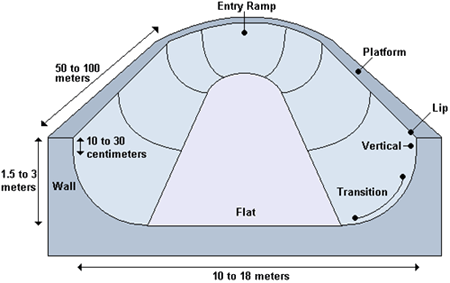
These are the Elements of a Halfpipe:
- Flat
Is the center flat floor of the Halfpipe
- Transitions/Trannies
The curved transition between the horizontal flat and the vertical walls
- Verticals/Verts
The vertical parts of the walls between the Lip and the Transitions
- Platform/Deck
The horizontal flat platform on top of the wall
- Entry Ramp
The beginning of the halfpipe where you start your run
Halfpipe Snowboarding
Before you start, keep this in mind: a Halfpipe is no beginner's terrain. You will need excellent edge- and turning control before you try your first run. Make sure you are able to ride fakie as well since you'll probably do it a lot in the Halfpipe. It would help a lot with the transitions between the flats and the walls of the pipe if you can jump smoothly. Moreover, to make your run less trying when you start out, try starting a bit further down the pipe. You can go further up the pipe to take your runs as you improve your skills.
Traversing
When riding the Halfpipe for the first time, it is important that you practice first. You can do this by simply traversing the transitions of the Halfpipe, similar with what you did when
Learning How to Ride Down Regular Slopes. It is a weird sensation going up and down the same slope when all you are used to are one way descends.
Slide Turns
Once you have quite gotten the feeling, you can try real turns. You will be making turns up and down the same slope so you have to learn how to roll your edges. Rolling your edges means that you will be ascending the transition with one edge and descending with the opposite edge. Practice the Slide Turns by going higher and higher up in the transition.
Jump Turns
Once you are going higher and higher up the wall, you will at one time almost take-off into the air, leaving the lip of the wall. Go for it and make a little jump at the lip, and turn in mid air. As with all jumps, keep your knees bent in the landing and close to your body while in the air. Try getting more and more air and make sure to concentrate on the lip. You do not want to land on the platform with your nose digging into it.
Well, those are the basics of riding the Halfpipe. As you are able to jump higher and higher you will probably want to start showing off some tricks. You can read and learn all about Halfpipe tricks in our
Halfpipe & Obstacle Tricks section.

Users who read this article also read the following articles:
|
Sunday 27th September 2009 at 4:04:23 AM
Here in Pamporovo we have a half pipe, but it''s really a beginners one. So it was easy for me to learn how to ride it. And the most important thing for me was building up a momentum while riding in the pipe. Once you drop down the walls it''s good to just practice riding in the pipe and building speed. This will help you later on with the tricks and the speed that''s needed to perform higher jumps and more advanced tricks.
Monday 9th November 2009 at 10:52:43 PM
is this a old Schematic? i think most pipe now is 3-5m from lip to flat. being tal i pefur 5m.
Tuesday 26th January 2010 at 4:51:46 AM
helo may we have your half pipe use as a picture for our made website
goodbye
Robert and lesley
Friday 12th February 2010 at 10:38:29 AM
iloveyou :)n a lil d here n there. comment back. from david fedewa portland michigan
Friday 19th February 2010 at 3:08:59 AM
Is there a vertical decline from the entry to the finish line? How steep?
Wednesday 3rd March 2010 at 5:28:22 PM
your website is the best i Lve you
Thursday 18th March 2010 at 3:54:20 PM
Maybe post what its about and not how to play it.
Name: (required)
Email Address: (will not be published) (required)
Website:
Comment: