Snowboarding Injuries and Prevention
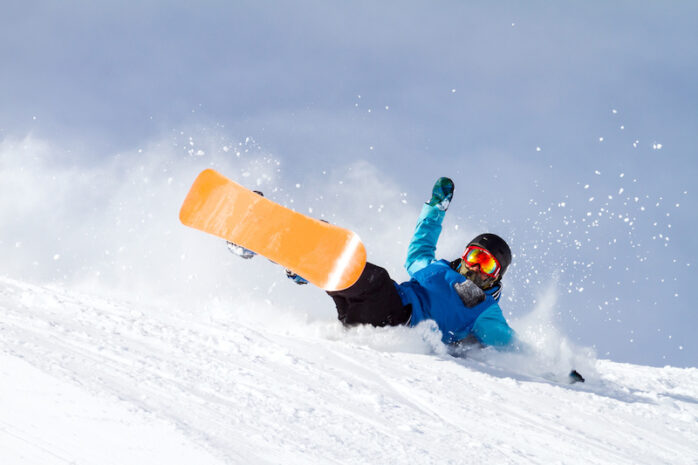
Snowboarding is an extreme winter sport with a considerable chance of injuries ranging from innocent little slips to high impact crashes. Beginning Snowboarders are the ones who normally get injured even though they attempt less dangerous maneuvers than advanced Snowboarders. This is because they haven't learned how to maintain a stable stance on the Snowboard yet and are thus more likely to lose balance and fall. In fact, nearly 25% of injuries occur during a snowboarder's first experience and almost one-half occur during the first season of Snowboarding.
Considering the fact that both of your feet is fixed in non-release
Snowboard Bindings to a relatively narrow
Snowboard, it is logical that "falling" is the leading cause of injury in Snowboarding. Falls are followed by collisions with stationary objects and other snowboarders or skiers. The overall injury rate is estimated to be 4 per 1,000 snowboarding days, similar to that in
Alpine Skiing.
Compared to
Skiing, Snowboarding injuries usually involve the upper extremities and the ankle. This is because when Snowboarders lose their balance, they can't "step out" a leg in order to recover, as both feet are firmly attached to the board. The instinctive protective reaction in the event of a Snowboard fall is to outstretch a hand to break the landing, thus placing the upper limb at risk of injury. Nevertheless, serious injuries are rare in Snowboarding and generally occur from collision with trees. Wrist injuries are by far the most common of all Snowboarding injuries, followed by ankle and knee injuries.
In this section we are going to look at some of the dangers and injuries in Snowboarding.
Wrist Injuries
Wrist injuries are by far the most common Snowboarding injuries. Slipping backwards and landing on your hands is a common occurrence especially for those who are just
Learning How to Ride. Hard impacts of those slips can cause sprains or even fractures.
Wrist injuries tend to occur when Snowboarders lose their balance, subsequently falls, and instinctively react by outstretching a hand in order to try and break the fall. This mechanism is known as a 'FOOSH' (Fall Onto an Out Stretched Hand) amongst emergency department staff. As a result, the wrist is the single most common site of injury amongst Snowboarders - an area that is rarely injured in Alpine Skiing.

When you slip back, try not to catch your fall with your hands because by doing so, you will be placing all the impact on your wrists. It would be better to teach yourself to fall on your elbows. As you fall backwards, keep your hands in front of you and point your elbows backwards.
Your elbows are able to absorb a much harder impact than your wrists. Better yet, try to keep your arms safely tucked in. It is better to roll out of a fall, distributing impact over a greater portion of the body.
Wrist guards are the best method of injury prevention. Using wrist guards are especially important during your first week of learning to Snowboard. Some glove manufacturers make gloves with integrated wrist protection. Wrist guards made for
Inline Skating or skateboarding can also work for Snowboarding, and can be worn either under or above your mittens or gloves. You can buy them as separate pieces of gear or integrated into gloves or mittens.
We sell Wrist Guards Here >>>
Ankle Injuries
Standard Snowboarding places a lot of pressure on your ankles and calves. Ankle injuries occur mostly from hard sideway impacts such as crashes and are particularly common after jumping when a combination of compression and inversion (the ankle turning in) forces are experienced. This may lead to an ankle sprain or to a more serious condition called "snowboarder's ankle" - a fracture of the lateral process of the talus. Expert riders tend to have more ankle injuries, although the risk is decreasing as better ankle support is added to
Snowboarding Boots.
As with
Skiing, your
Snowboard Gear has a significant effect on the type and frequency of certain injuries. Generally, the risk of sustaining an ankle injury as a Snowboarder is related to the kind of Snowboard boots you wear:
- Hard Shell Boots tend to be worn by more experienced boarders and (as with Ski Boots) tend to protect the ankle joint.
- Soft boots are favored by beginners because they allow some degree of ankle movement, which helps the rider to maneuver the board more easily. Unfortunately, soft boots give the Snowboarder about twice the risk of ankle injury compared with hard boots. Any forces transmitted back from the board tend to be absorbed by this joint. This normally happens when the ankle is either compressed or turned in (which can occur after a jump).
Although riders who opt for stiffer lace-up boots or alpine/carving boots are less likely to have ankle injuries, they may be nonetheless more prone to knee injuries. The softer your
Snowboard Boots and the looser your binding settings, the greater your risk of injuring a foot or ankle; this often results to a sprain or fracture. Still, the firmer your boots and the tighter the binding settings, the greater your risk of injuring a knee; this often results in ligament damage or ruptures.
If you're a beginner, keep your bindings set relatively loose to spare your knees during falls. As you improve, you can gradually tighten the bindings to improve your control over the board. Keep in mind that
Hiking Boots or "moon boots" should never be worn for Snowboarding as they considerably increase the risk for serious injury.
Knee Injuries
The knees are the natural springs that absorb most of the shocks during snowboarding. However, compared to Skiing, knee injuries are less common and less severe in snowboarding for several reasons. First, a
Snowboard only has Two Edges that can "catch" unexpectedly on snow as opposed to the
Four Edges on Skis. Also, Snowboards tend to be shorter than skis; hence the "lever arm" of force produced by any twist is reduced.
Most knee injuries in Snowboarding are caused by extremely hard collisions (such as when you hit a tree) or impacts from unexpected angles or turning motions. To avoid such injuries, make sure you know your limitations. Keep in mind that as your Snowboarding technique improves, your ability to absorb harder impacts will also intensify. Also, while Snowboarding, make sure you keep your knees bent at all times, especially when performing jumps or tricks.
We sell Snowboard Protection Knee Guards Here >>>
Head Injuries
Crashes with natural objects, such as hard snow surfaces or ice, rocks and trees, or unnatural objects such as rails and boxes in
Snow Parks, can cause serious head injuries. As a result, helmets are an essential component of any
Snowboarder's Protective Gear. Regardless of your abilities - whether you'll be performing freestyle tricks or
Snowboarding Off Piste or not - it is essential that you wear a Snowboard Helmet at all times. Remember that even a low speed, back slip on the back of your head can already cause serious head injury.
Although there's little doubt about the importance of wearing a
Snowboard Helmet, keep in mind that wearing a Helmet while Snowboarding does not make you invincible. There is no proof that wearing a Helmet will protect you from death or serious injury if, for example, you are going at or above the speed of a normal intermediate boarder (40-60 km/h) and collide with a static object (such as a tree). If you're going to calculate the gravity of the impact, the forces involved with such a collision are way beyond the capacity of all modern helmets. Still, Snowboard Helmets are certainly expected to be of benefit in more minor impacts, glancing blows and other similar mishaps.
When buying a helmet, choose the special Snowboard Helmet. They are stronger at the sides of the helmet where Snowboarding impacts are most likely to occur.
We sell Snowboarding Helmets Here >>>
Impact Injuries
Many injuries are caused by the Snowboarder's crash into an obstacle. Another source of injuries however is crashes with other skiers or Snowboarders. Especially on busy slopes, the chances of being hit by other practitioners increase. To avoid such crashes make sure to read and comply with the Skier and Snowboarding Guidelines.
Skiing and Snowboarding Guidelines >>>
A lot of Snowboarders opt to minimize their chance of injury by protecting their back, hips and torso as well. Using Body Harnesses and Shells are excellent ways of protecting your body.
We sell Body Protection Here >>>
Snowboarders, especially first-timers, would be wise to avail of some
Snowboard Safety Gear. Using wrist and elbow guards can ease the force of falls on the joints of the upper body. Knee pads on the other hand help prevent contusions; a pad for the tailbone is also essential since beginning Snowboarders spend a lot of time on their backside.
While both skiing and Snowboarding are done on the snow on a mountain, remember that they are very different in terms of technique. Being a good skier does not guarantee that you will be an expert on a Snowboard. In fact, taking a lesson is always the best way to start Snowboarding, to develop proper technique, and even to reduce the risk of injury. Experienced Snowboard instructors can teach beginners how to stay up as well as how to fall - both are essential skills to have for a pleasurable day on the slopes.
Monday 1st February 2010 at 4:39:12 PM
thank you for sharing this information
Tuesday 2nd March 2010 at 11:39:57 AM
oh my god i fell on my head the other day it hurt so bad when i got my helment knee pads and wrist pads a feel so much safer thank you!
Name: (required)
Email Address: (will not be published) (required)
Website:
Comment: