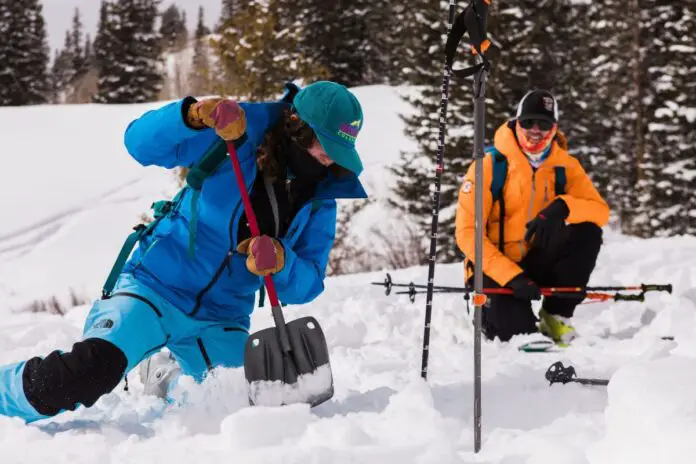
When you witness an avalanche, be sure to keep yourself away from the area, but do not also forget to rescue the victims (if any). Rescuing an avalanche victim is very critical. This section covers some basic guidelines when it comes to avalanche rescue:
1. Don’t bring more victims to the area
The first thing to remember when rescuing is to make sure that the area is safe before conducting the procedure. Check the regions if the avalanche appeared to have finished and settled. Observe carefully and see if there are no further avalanche dangers for your team. If it is not safe to continue, do not attempt to rescue first, it would be more disastrous if the rescuers were to be rescued as well.
Avalanche RescueOnce the area is safe, you may conduct the rescue. Post an avalanche guard who will alert everyone if another avalanche is on the way. Also, have a signal for your team (a hand wave, whistle, a shout, etc.) so you will be able to communicate with others easily. Remember to make an escape plan for your team if all else fails.
Time is very critical during this kind of situation so do not spend too much time on the details. Someone must take charge so that instructions will only come from one source. It is hard to rescue people if the rescuers are arguing, so make sure that a person in authority would be present in the situation.
2. Mark critical information
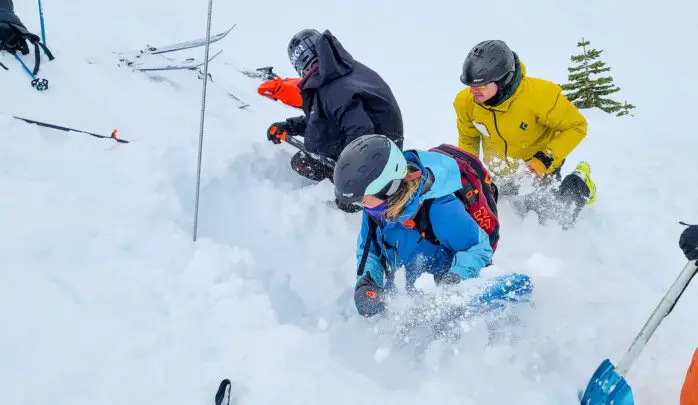
Where was the last seen area?
Identifying this point could save you a lot of searching on its uphill side and on either side. The victim will be buried somewhere within a cone that flows from this point down the fall line.
Where was the person’s entry point into the slide area?
This point, combined with the last seen area and any surface clues, can help to determine a line-of-flow and a high probability search area.
Was there a witness?
Witnesses can save you time and they can give you important information like the number of people you’re looking for. They can also provide credible details that the rescuers can rely on. If you have a big group, assign someone to keep track of the witness/es.
Are there any surface clues?
The position of the equipment on the slide path can help in determining the line of flow of the victim and his or her possible location. Clues like this might also actually be the victim.
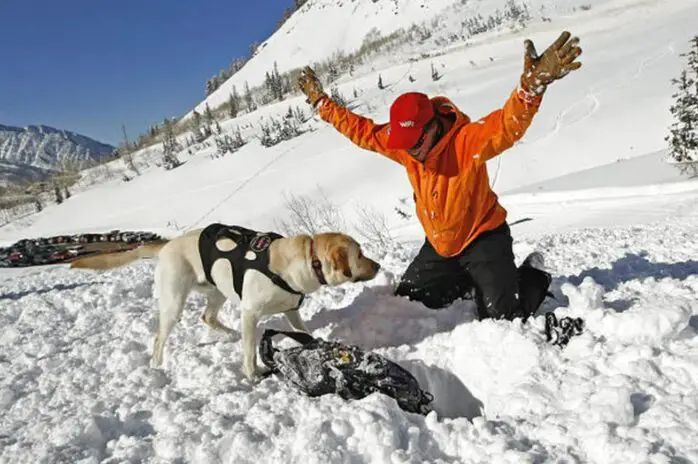
At this point, it is also a good idea to quickly establish an entry and exit point and a “cache” area to leave any unnecessary gear. Anything that is on the slide area is a clue such as tracks in and out, equipment and clothing, piles of avalanche debris, etc. The rescuers should make every attempt not to confuse the scene. This extends to scents as well. If the rescue goes badly, an avalanche dog may be brought in.
3. Beacon Search
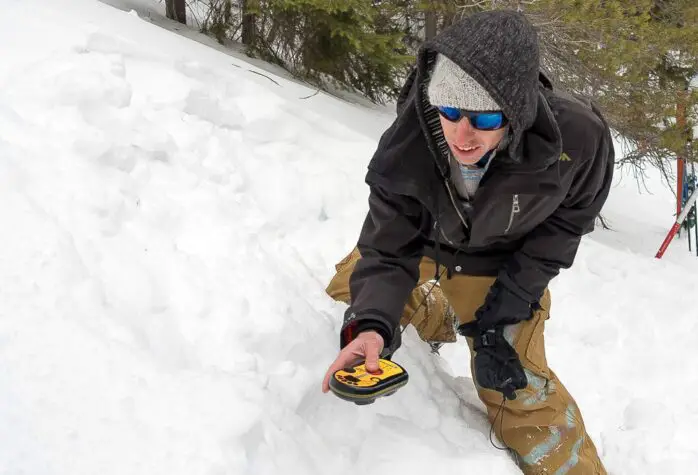
The best and fastest way to start a rescue is through the use of a beacon or transceiver. Everyone in the team must have their beacons on so as to receive signals immediately.
If the path is narrow and the rescuers are skilled enough, one or two people can conduct a quick and thorough search of the entire path while the others get their beacons and shovels out. It is a good idea to limit your searchers if you aren’t sure if the victim is even wearing a beacon. If he isn’t, you’ll need people high on the path to begin probing quickly. If they’re all at the bottom, you’ll waste time waiting for them to hike back up again.
Once you’ve picked up a signal, send more searchers and diggers to help. Probing can also speed up the rescue. Of course, the search should continue if there is more than one buried victim.
Clear the victim’s head first. You can begin rescue-breathing and CPR while others finish excavating. People who have been buried in an avalanche get very cold and very beaten up. Check for signs of Hypothermia and traumatic injury.
4. Probing
If the victim does not have a beacon, the rescue will be more difficult and time-consuming. Rescuers must now conduct probing. This is done by poking long rods into the snow until you strike the victim. From there, you can dig him out of the snow. He might have dents and bruises from the poking but it is better than being buried in the snow.
Examine and quickly probe surface clues. If you find a glove, pull it out – it may have a hand attached to it. Probe high-probability areas; the uphill side of trees in the slide path, the outside of bends in the path, low angle areas of the path, etc. Establish a line of flow using surface clues, then set up a probe line at the bottom of this line at the toe of the debris.
5. Course & Fine Probing
The purpose of a probe line is to cover the avalanche debris with a grid of regularly spaced holes. If you are precise in your coarse-probing, you have a 70% chance of striking a buried victim. If you are not careful and exact, the odds are much lower.
To conduct a coarse-probe line, space the probers out at 75 cm intervals (hands on hips, elbow to elbow). Someone needs to stand in front to give commands and watch the straightness and spacing of the line. Everyone should probe just ahead and between their toes and should probe and move only on command. Here are some tips:
- Work uphill. Probelines headed downhill are hard to keep straight.
- If someone gets a strike, he or she should yell it out, then leave the probe in place. Send a shoveler to dig for whatever was hit. Give the prober a new probe so the line can keep moving (false strikes are not uncommon).
- A regular Ski Pole with the basket removed works better than nothing.
- At this point, you’re still looking for a live person, so move quickly but precisely!
- Some probes are really long – just worry about the top six feet, for now.
- Mark the probed areas.
- If you have more than 10 probers, you may want to break the group into two probe lines working in different areas – big lines are hard to control.
- Use a guidon cord, if you have one, to keep the line neat.
- If you probe all the debris and don’t find anything, go back over it again. Keep it up until you are sure you’re looking for a dead body (1.5-2 hrs), then you can send someone for help and begin a fine-probe search.
If regular probing fails, you will have to use fine probing. This is 95% accurate but very time-consuming. It’s for finding bodies, not living victims. It’s quite the same as the coarse probing, but have the line step forward one-third as far and probe in front of both toes as well as in between.
These tips and guidelines must be kept in mind by people conducting a rescue. If you are a first-time rescuer, do not risk your own life over the others. Remember not to panic and be alert, for one will never know when an avalanche might strike again.